Hello, everyone! I’m excited to share a major milestone from Pixel Tracker, which nailed its first real-world election prediction.
The Origins of Pixel Tracker
Earlier this summer, I embarked on a personal passion project called Pixel Tracker—an innovative app designed to track and analyze the online activity of Albanian politicians. In a digital age where social media shapes public opinion, Pixel Tracker aims to decode the signals behind political momentum. From post engagements to audience growth, it provides a window into the virtual campaigns that influence real votes.
This tool is still in its beta phase, but its potential is already shining through. We’re testing advanced features like sentiment analysis on comments and AI-generated text detection in posts, ensuring it becomes a reliable ally for data-driven decision-making
The Tepelena Test: A Real-World Prediction
In its inaugural trial, Pixel Tracker forecasted the voter turnout and results for the recent Tepelena municipal election with remarkable accuracy—delivering the projection two full days before election day on November 9, 2025.
Tepelena, a municipality in southern Albania, saw a contest between Gramoz Sako of the Socialist Party and Gabriel Guma of the opposition. With limited traditional polling data available, I turned to social media as a proxy for public sentiment and engagement.
Behind the Scenes: The Methodology
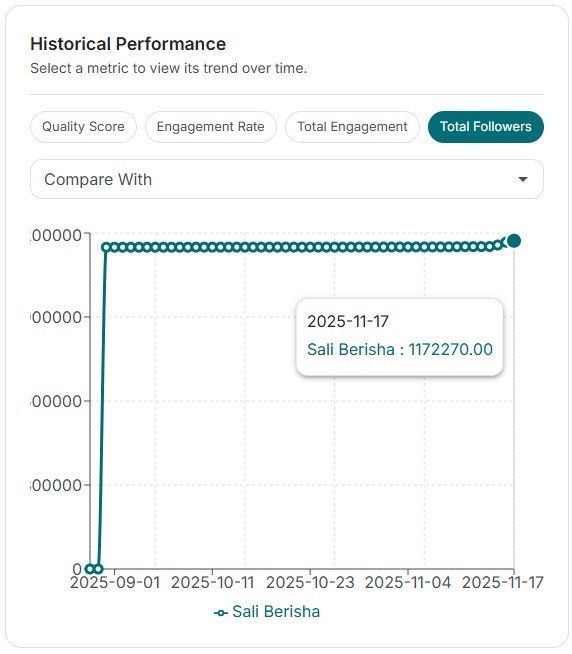
To power these insights, I developed a custom metric called the “Weighted Quality Score.” This score enables daily predictions of impressions on each politician’s Facebook page—a key metric that Facebook doesn’t expose through its public API (you’d need admin access to retrieve it directly). By combining this with daily graphs of the Weighted Quality Score and trends in follower changes, I could quantify the digital momentum for both candidates.
The prediction process involved running four distinct simulations, each with varying weights assigned to these metrics. To ground the models in reality, I incorporated contextual data such as:
The number of eligible voters in 2025
Voter turnout and invalid votes from the 2023 election
This blend of social media signals and historical context directly influenced the projections, turning raw data into actionable forecasts.
The Projections vs. Reality
Our first projection, generated on November 1st using data from October 18th to 31st, estimated:
Gramoz Sako (Socialist): 76.00% share, ~3,900 votes
Gabriel Guma (Opposition): 24.00% share, ~1,231 votes
The second and final projection on November 7th, incorporating data up to that date, refined it to:
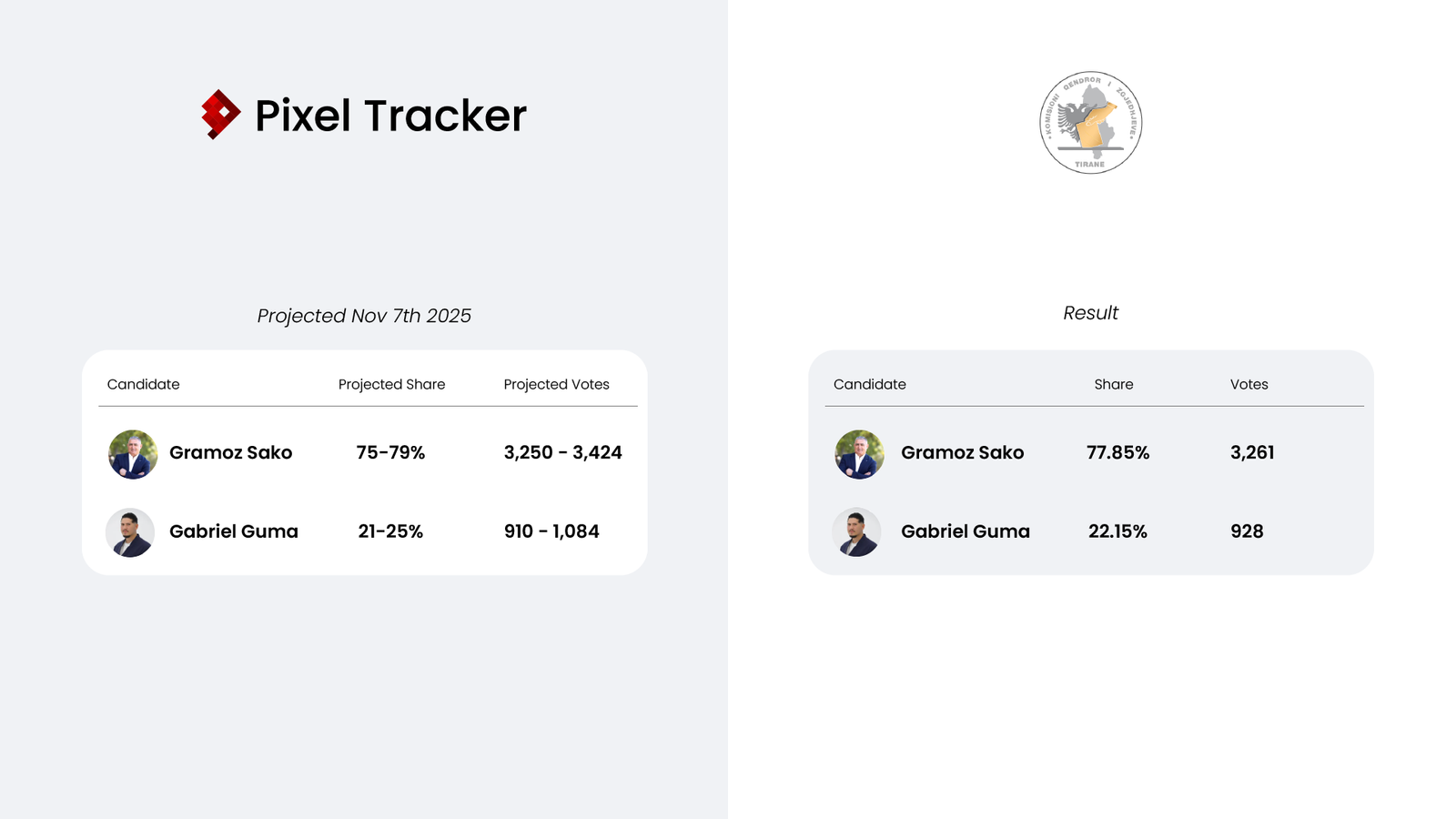
Gramoz Sako (Socialist): 75-79% share, 3,250-3,424 votes
Gabriel Guma (Opposition): 21-25% share, 910-1,084 votes
Now, compare that to the official results from Albania’s Central Election Commission (KQZ/CEC):
Gramoz Sako (Socialist): 77.85% share, 3,261 votes
Gabriel Guma (Opposition): 22.15% share, 928 votes
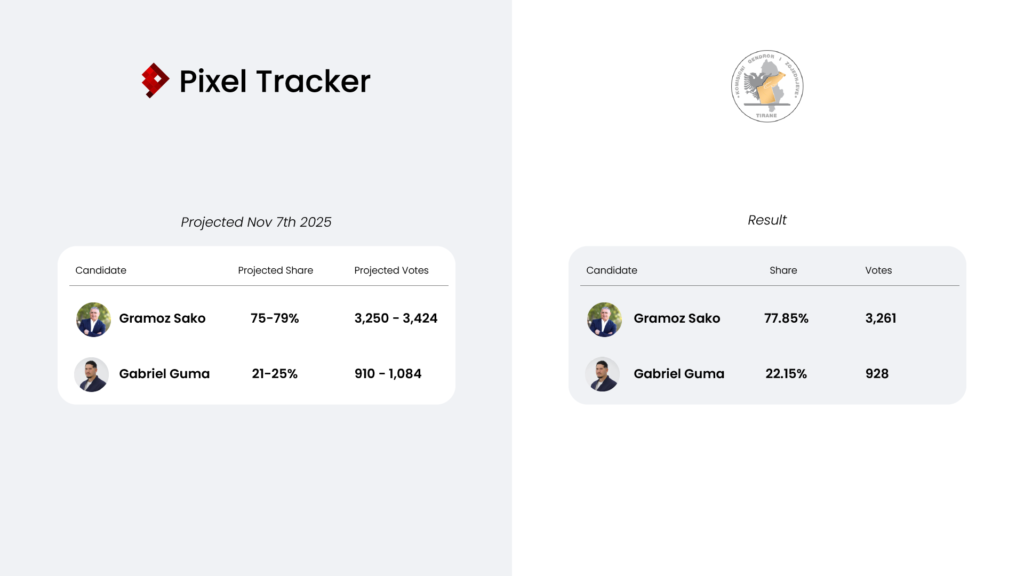
The alignment is striking! Pixel Tracker not only captured the winner but also the vote shares and totals with near-perfect precision. (Insert side-by-side image comparison here: Left—Pixel Tracker’s final projection; Right—Official CEC results.)
What’s Next for Pixel Tracker?
This success validates the power of social media analytics in electoral forecasting, especially in regions like Albania where digital platforms are a primary battleground for political influence. Pixel Tracker is evolving rapidly, and by early 2026, it will be generally available to journalists, researchers, and campaign strategists in Albania.
Looking ahead, we’ll launch Pixel Tracker Business, expanding its capabilities for enterprise users. Features in the pipeline include deeper AI integrations for real-time alerts and customizable dashboards.
Stay tuned for more updates from Pixel Tracker.