

1. Project Vision & Scope
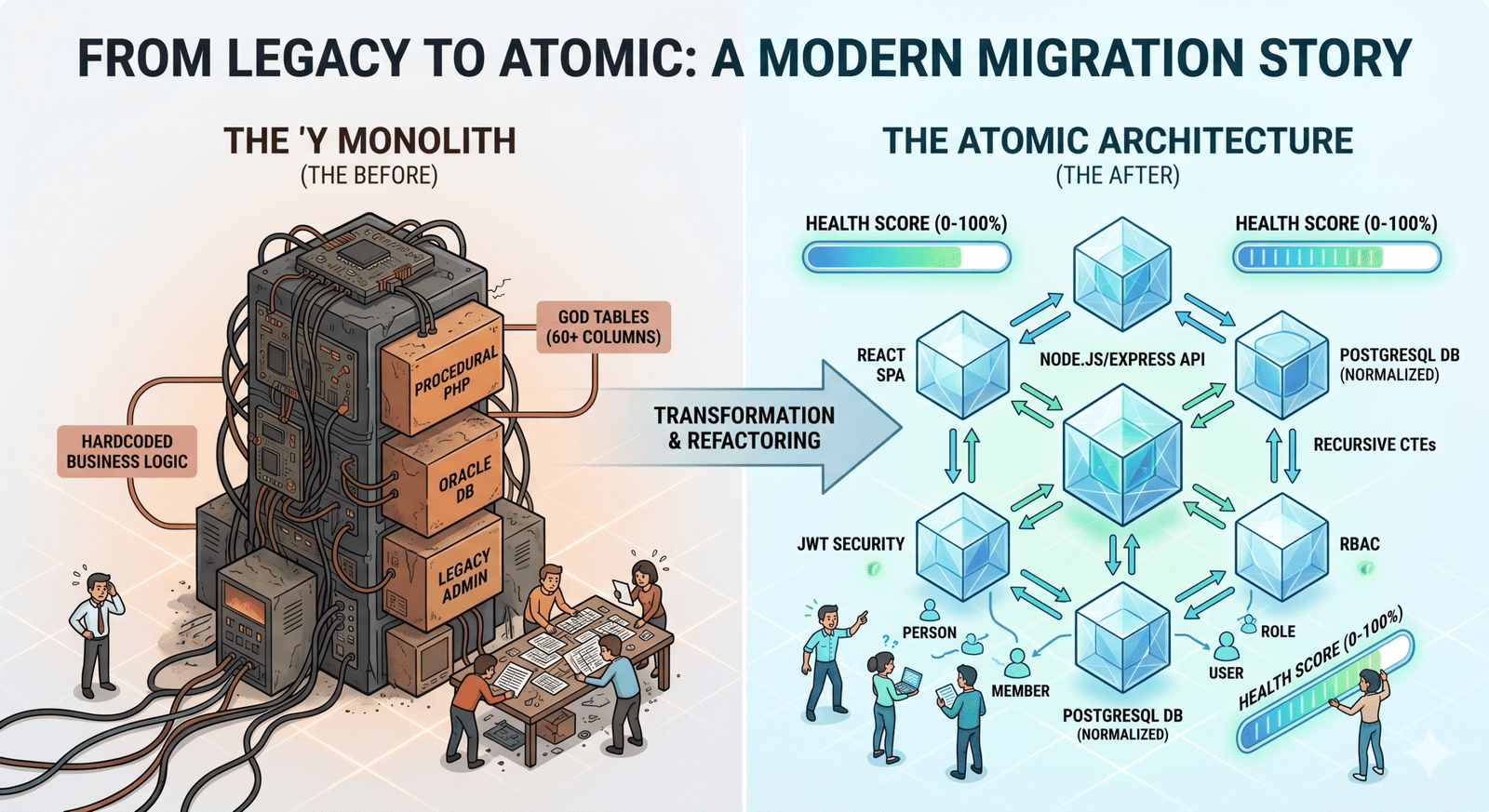
This Administrative Ecosystem Re-Engineering project aimed to perform a complete architectural overhaul of a mission-critical membership and administration system for a high-level organization. Our goal at Pixel.al was to move beyond basic maintenance, transforming a rigid, legacy environment into a modern, three-tier web ecosystem engineered for high-performance data processing, granular security, and long-term strategic scalability.
2. The Legacy Landscape: Navigating Technical Debt
Before beginning the Administrative Ecosystem Re-Engineering process, we audited a monolithic system characterized by decades of procedural technical debt.
- The “God Table” Paradigm: The legacy database relied on massive, denormalized structures where a single entity could contain over 60 columns, leading to severe data redundancy.
- Schema-Level Hardcoding: Business logic was frequently “baked” into the database schema itself, making the system brittle and expensive to maintain.
- Procedural Persistence: Data interactions were handled through manual SQL string concatenation in a procedural PHP environment, making security auditing nearly impossible.
3. Architecting the Future: The Atomic Shift
A core solution in this Administrative Ecosystem Re-Engineering was the implementation of a highly normalized, atomic architecture using a modern tech stack.
- Domain-Driven Separation: We decoupled the monolithic entities into distinct, relational domains, ensuring a single source of truth for person-centric data.
- Dynamic Role Mapping: We implemented an organizational layer that tracks memberships and roles through polymorphic relationships rather than hardcoded columns.
- Modern Frontend Delivery: The UI was rebuilt as a React Single Page Application (SPA), utilizing Material 3 Expressive design principles to provide a premium, high-contrast experience.
4. Comprehensive Migration Strategy: Data Transformation
The most critical phase of the Administrative Ecosystem Re-Engineering was the “in-flight” transformation of data from the legacy environment to the new atomic schema.
- Stage 1: Structural Extraction: We developed specialized ingestion scripts to extract data from legacy structures and map it into the new relational model.
- Stage 2: Multi-Pass Identity Resolution: To handle years of data accumulation, we implemented a memory-based audit strategy during the migration to identify, clean, and merge duplicate records instantly.
- Stage 3: External Reference Validation: During the transition, migrated identities were cross-referenced against authoritative reference datasets to ensure data integrity.
- Stage 4: Performance Indexing: Post-migration, we implemented advanced GIN trigram and B-Tree indexes in PostgreSQL to ensure high accuracy for local data entry.
5. Engineering for Scale: Performance & Analytics
To maintain sub-second response times, this Administrative Ecosystem Re-Engineering utilized several advanced engineering patterns:
- Recursive Data Aggregation: We utilized Recursive CTEs (Common Table Expressions) to traverse the organizational hierarchy, allowing for real-time roll-up of statistics in a single database round-trip.
- O(1) Audit Strategy: For bulk processing and imports, the system utilizes a memory-based strategy that fetches relevant data for instant lookups.
- Health Score Visualization: We introduced an interactive Health Score (0-100%) metric to drive a culture of data quality.
6. Security & Governance Architecture
Security was treated as a first-class citizen throughout the Administrative Ecosystem Re-Engineering:
- Hardened Authentication: The system implements Node.js powered JSON Web Token (JWT) authentication, signed via the HS256 algorithm.
- Granular RBAC: Access is governed by Role-Based Access Control, ensuring complete isolation between departments.
- Audit Logging: Every administrative action is captured in a high-fidelity audit trail for full traceability.
Conclusion
By successfully executing this Administrative Ecosystem Re-Engineering, we eliminated years of technical debt and established a high-performance foundation for future digital expansion. Learn more about our services at Pixel.al.
